
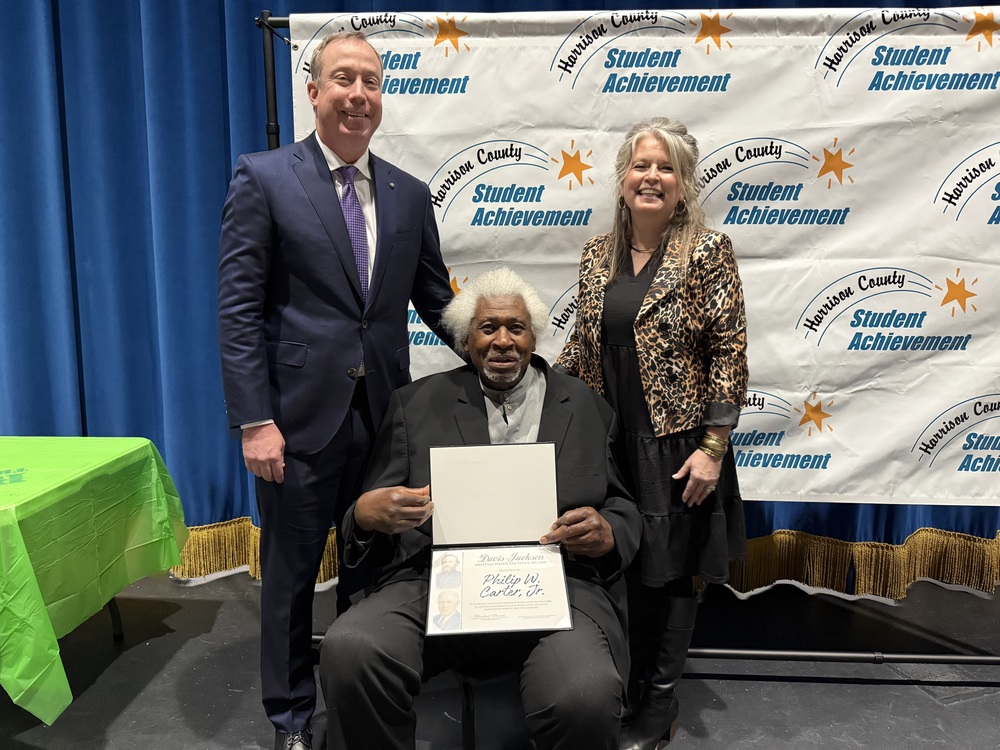
Professor Emeritus Philip W Carter, JR., MSW was a professor of social work. Raised in Clarksburg, he was among the students who were integrated into Washington Irving High School after the closure of segregated Kelly Miller High School in 1956. Backed with a Bachelor of Arts in Political Science from Marshall University and a Master of Social Work from the University of Pittsburgh, the passionate educator would dedicate most of his life to furthering the education of others. With 43 years of service at Marshall University in Huntington, West Virginia, and a total of more than 50 years of teaching and training in higher education, Carter taught and developed coursework in areas of Appalachian social welfare and legislation, and African Social Work. But that is not the only legacy Carter has forged over his lifetime; he is well known for his work as an advocate of social justice. Carter and his wife, Beverly, married for 61 years, are the proud parents of their 3 children, Philippa Kay, Stacey Lynn, and Frederick Dubois.
The Clay County native would begin his journey in social justice at an early age before entering the campus of Marshall University in 1959. Although basketball led him to join the “thundering herd”, he also answered the call to become a voice for social justice. He co-founded the student-led group named Civic Interest Progressives (CIP). Desegregation in public accommodations, the establishment of human rights commissions, and racial betterment at Marshall and across the Tri-State Area can be attributed to the ground-breaking work of the CIP students.
In 1962, Carter would make history that would originate from our nation’s Capital. U.S. Representative Ken Hechler would appoint him to the U.S. Capitol Police Force. This made Carter the first undergraduate athlete in West Virginia to receive a federal appointment at this level. At age 26, he was one of the highest-ranking leaders of the Congress of Racial Equality (CORE) based in Cleveland, Ohio. Nationwide, Carter would employ sit-ins, picketing, voting, economic disruption, share-ins, and other non-violent protests to secure equal rights for the Black American population.
After serving as an instructor/trainer at the University of Oklahoma for the federal government’s Job Corps employees in 18 states across the U.S. and studying at the University of Pittsburgh’s Graduate School of Social Work and Graduate School of Public and International Affairs, his love for social justice and academia led him back to his alma mater, Marshall University, in 1980. Serving as the director for the university’s social work program, Carter would successfully advocate for the program’s accreditation to become the Department of Social Work. He would later serve as the department’s chairperson and become the first faculty member from the Department of Social Work to receive tenure in 20 years.
Carter has achieved at many levels, beginning with his all-conference basketball awards at Washington Irving High School and Marshall University during the 1950’s and 1960’s. He was also recognized by the Clarksburg-based WV Black Heritage Festival. Carter, who would also serve four terms as president of the Huntington-Cabell Chapter of the NAACP, received many honors for his work in bringing about social justice. In 1999, The Herald Dispatch recognized him as one of the “50 Top Influential Leaders in the Tri-State for the 20th Century. In 2011, Carter was inducted into the West Virginia All-Black School Sports and Academic Hall of Fame as a Lifetime Achievement Award recipient. In 2017, Carter and his wife, Beverly, were recognized by the Fairfield community, a neighborhood in Huntington, for their social justice work. Recently, Huntington, West Virginia, approved Williams ' designation of an area on 9th Street, between 4th Avenue and 5th Avenue, as Phil Carter Plaza during a public ceremony, and recently, Clarksburg City Council approved naming the new bridge in Clarksburg after Philip W Carter Jr.